Table Of Content

Anyone who’s ever tried to mix and match multiple printed pillows with a statement rug knows that mixing patterns is more complicated than you think. It takes a shrewd eye and fundamental knowledge of both design and color theory to pull it off. The test will be run at a level of significance (\(\alpha\)) of 5%. An independent testing agency is comparing the daily rental cost for renting a compact car from Hertz and Avis. Using the difference data, this becomes a test of a single __________ (fill in the blank). Variable(s) that have affected the results (DV), apart from the IV.
Here is How to Find the P-Value from the t-Distribution Table
The mean consequences of the matches would be analyzed after the trial. Matching also eliminates the possibility of studying the effect of matching variables on the outcome (for example as a secondary objective of the study). Picking the wrong matching variables is problematic as it is irreversible.
Excel: How to Use IF Function with Multiple Conditions
One summer institute hosted 20 French teachers for 4 weeks. At the beginning of the period, teachers were given a baseline exam covering Modern Language listening. After 4 weeks of immersion in French in and out of class, the exam was administered once again. Do the results give convincing statistical evidence that the institute improved the teacher’s comprehension of spoken French? You can get a copy of the data table in Google Sheets format here. Since we are being asked for convincing statistical evidence, a hypothesis test should be conducted.
Randomization And Control
Colors That Go With Olive Green — 10 Calming Combinations For a Cozy Home - LivingEtc
Colors That Go With Olive Green — 10 Calming Combinations For a Cozy Home.
Posted: Mon, 19 Feb 2024 08:00:00 GMT [source]
It helps reduce variability and draws clear conclusions on cause-effect relationships. Let’s explore the core principles behind this powerful statistical approach. To compare two means we are obviously working with two groups, but first we need to think about the relationship between them.
Qualitative vs. Quantitative Variables: What’s the Difference?
Variables such as gender and age cannot be modified and therefore are perfect candidates to be used for matching. In other words, if we take each pair alone, the choice of who gets the treatment and who doesn’t is completely randomized. Statology Study is the ultimate online statistics study guide that helps you study and practice all of the core concepts taught in any elementary statistics course and makes your life so much easier as a student.
The independent models shown above compared samples that were not related. However, it is often advantageous to have related samples that are paired up – two measurements from a single population. The model we will consider here is called the matched pairs \(t\)‐test also known as the paired difference \(t\)‐test. The advantage of this design is that we can eliminate variability because other factors are not being studied, increasing the power of the design. Studies that employ smaller sample sizes generally have financial constraints or time constraints, making it unfeasible to have a larger sample size.
For each experiment, identify (1) which experimental design was used; and (2) why the researcher might have used that design. We expect the participants to learn better in “no noise” because of order effects, such as practice. However, a researcher can control for order effects using counterbalancing.
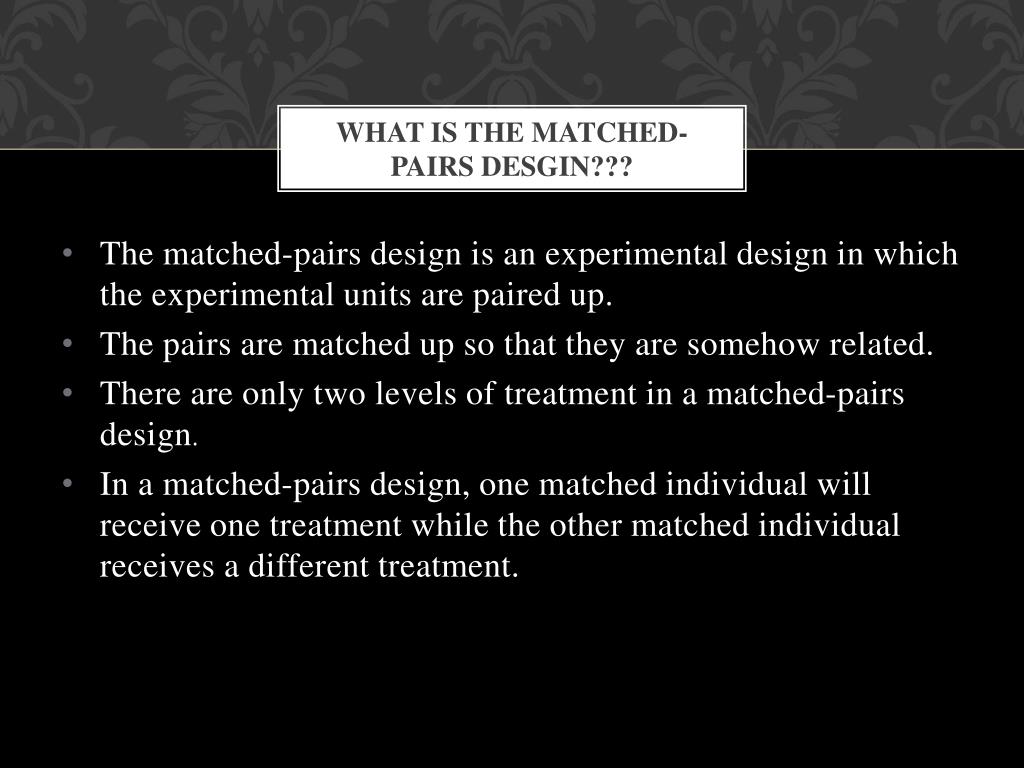

Matched pairs design is a research method used in experimental and quasi-experimental research to control for extraneous variables and reduce the influence of individual differences among participants. In this design, participants are paired based on similar characteristics or traits that are relevant to the study, such as age, gender, or socioeconomic status. Each pair is then randomly assigned to either the experimental group or the control group, ensuring that each group has a similar distribution of the matching variable.
Go all-out with a patterned sofa or accent chair, and take things one step further with an accent print, like a classic stripe. Paired with a solid rug or clean white walls, the look feels elevated and charming. Wallpaper is coming back, and we’re so in love with the artful, slightly nostalgic look. Similar to a patterned rug, you can absolutely center an entire design around a favorite wallpaper — your selection will set the tone for the color palette and overall aesthetic. Just remember to balance out the look with solid upholstery or a toned-down rug.
A lurking variable is a variable that is not accounted for in an experiment that could potentially affect the outcomes of the experiment.
The data given here would indicate that the distribution is actually right-skewed. The means of the other three data values are actually negative. A wide confidence interval suggests more data may be needed. A large effect size speaks to the difference’s importance. You have learned to conduct inference on single means and single proportions. We know that the first step is deciding what type of data we are working with.
This is because it is harder to obtain balanced groups when using small sample sizes, even with the use of random assignment. A matched pair in statistics occurs when researchers pair subjects based on similar characteristics before applying different treatments. For example, identical twins receiving different diets to study the effects on weight loss. By matching subjects based on key characteristics, this design enhances the accuracy of attributing any observed differences to the factor under investigation rather than to extraneous variables. This statistical method is especially useful in small sample sizes and can be applied across various fields, from medicine to social sciences, providing insightful data for making informed decisions.
This method minimizes the impact of confounding variables, leading to stronger, more reliable conclusions. Independent measures design, also known as between-groups, is an experimental design where different participants are used in each condition of the independent variable. This means that each condition of the experiment includes a different group of participants. Then, within each pair, one subject will randomly be assigned to follow the new diet for 30 days and the other subject will be assigned to follow the standard diet for 30 days. At the end of the 30 days, researchers will measure the total weight loss for each subject. Researchers observe how different social factors affect them.
Scale, or the size of the print, should vary between each textile. For example, you can mix a busy leopard print chair with a classic oversized check, or a small floral print with a wide cabana strip. This visual mix ensures balance, contrast, and interest. Textbook content produced by OpenStax is licensed under a Creative Commons Attribution License .


No comments:
Post a Comment